




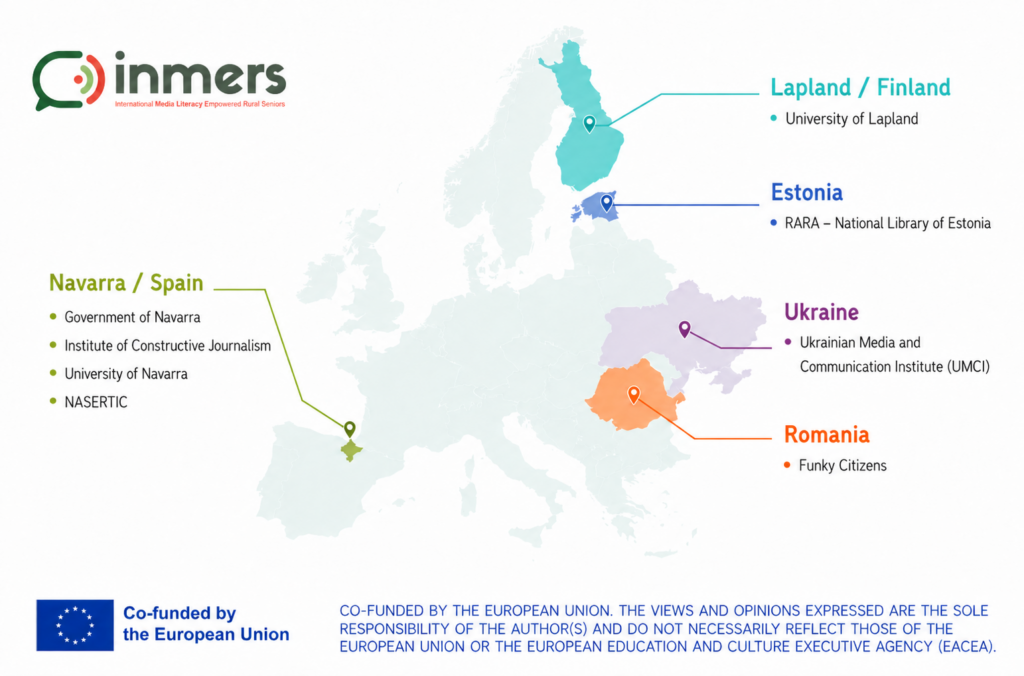


This international project is led by the Government of Navarra, in collaboration with the University of Lapland, the University of Navarra, Funky Citizens (Romania), and the Institute of Constructive Journalism of Navarra.
The Government of Navarre acts as the Project Coordinator, bringing extensive experience in European project leadership and public policy design. It plays a central role in ensuring strategic alignment with regional, national, and EU priorities. Its responsibilities include overall project management, financial and administrative coordination, and risk monitoring. The entity also leads communication, dissemination, and sustainability efforts. Through its institutional capacity, it ensures effective governance and long-term policy impact.
Funky Citizens (Romania) is a civil society organisation promoting good governance, civic empowerment, and media literacy, with proven expertise in countering disinformation. Its initiatives at the local level, centred around participatory approaches, have built direct experience engaging vulnerable and rural communities, which will be put to good use when implementing the pilot workshops in Transylvania. As leader of the co-creation working package, FC also coordinates the development of the Media Literacy Guide. Its approach is grounded in a long-standing commitment to building resilience against disinformation through critical thinking and scalable, replicable solutions.
The University of Lapland (Finland) contributes strong academic expertise in media literacy, particularly among older adults and in rural and Arctic contexts. It has significant experience working with indigenous Sámi communities and applying advanced diagnostic research methods. As leader of the diagnosis work package, it designs the methodological framework and coordinates regional analyses. The university also leads comparative research across participating regions. Its work ensures a robust evidence-based foundation for the project.
The University of Navarra (Spain) brings strong research expertise in media literacy, disinformation, and impact assessment. Through its School of Communication, it is actively involved in European research networks, including EDMO, enhancing its international perspective. As leader of the evaluation work package, it designs and implements the project’s evaluation framework. It oversees both baseline and final assessments, ensuring methodological rigor. Its work guarantees the measurement of outcomes and supports evidence-based recommendations.
Decide which cookies you want to allow.
You can change these settings at any time. However, this can result in some functions no longer being available. For information on deleting the cookies, please consult your browser’s help function.
Learn more about the cookies we use.